
Church makes the Holy Spirit a teaching topic (a preaching point). Ekklesia makes the Holy Spirit the Teacher who releases revelation and spiritual gifts through ordinary people in the meeting.
Church has made the Holy Spirit a lesson to learn by listening to a lecture. However, the Holy Spirit longs to directly lead His people when we meet together.
There is a place for teaching and preaching, but it is not supposed to completely eliminate everyday people from sharing in the meeting as prompted by the Spirit. God has used traditional church, and will continue to do so, but He wants to do so much more in the 21st Century. He’s ready to roll out His ekklesia, controlled not by a man, a method, a progarm, or an organization; but by the presence and power of His Spirit.
“The Holy Spirit, whom the Father will send in my name, will teach you all things and will remind you of everything I have said to you.” –Jesus (John 14:26) Paul of Tarsus says: “Quench not the Spirit.” He also asks this question: “After beginning by means of the Spirit, are you now trying to finish by means of the flesh?” (Galatians 3:3).
Perhaps it’s time for church to lay down its control and allow the living, resurrected Jesus the freedom to directly speak to and through ordinary people when we gather in His name. “Now to each one the manifestation of the Spirit is given for the common good.” (1 Corinthians 12:7)
After posting this article, I went to Facebook and the first thing I saw was a blog post that contained these words:
“It’s costly to move beyond the comforts of our status quo – even when the status quo is failing. It’s costly to see something fresh birthed from our churches. What is innovative and pioneering to us might be seen as disrespectful or threatening to others. There may be tensions, confusion, and rejection. It’s costly to invest future legacy in favor of current popularity. But our heart and communities carry a message of salvation that has transformed us and can transform our cities. We have been commissioned by a Savior whose love and power empowers us. So we press on, seeking fresh ways to share Jesus, not for the sake of something new, but for the sake of our communities, and for His glory.” –Joe Saxton in Fresh Expressions blog.
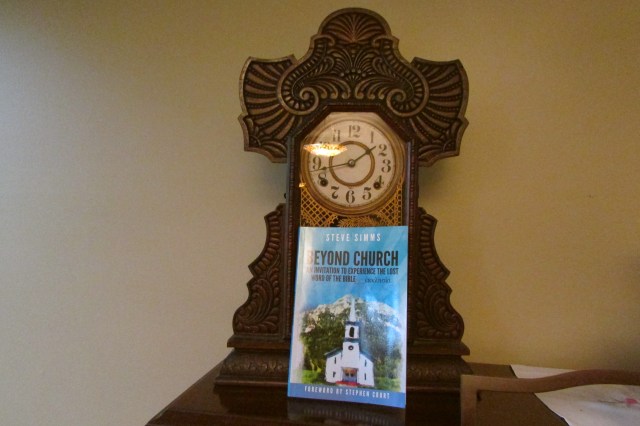
Perhaps it is time to go beyond church to ekklesia! Check out Beyond Church: An Invitation To Experience The Lost Word Of The Bible–Ekklesia at Amazon.


 Free Gas for Your Think Tank -- Short Reflections, Lasting Encouragement
Once again, Steve, I think you are right on target here. One of our favorite passages along this line is John 14:16. Jesus said, “I will ask the Father, and he will give you another advocate (NIV) to help you and be with you forever – the Spirit of truth.” Two key words here. First, the word translated “advocate” in the Greek is “paraklete”. Literally, “one called along side to help”. Perhaps a better modern translation is “coach”. The second word is “another”. The Greek word means “another one like the other one”. Who was the “other” paraklete? Clearly, it was Jesus Himself. So, Jesus’ disciples understood that they were to have the same relationship with the Spirit that they had had with Jesus for three years. Sometimes we summarize all of this by saying we want to have “a radical commitment to Jesus’ theology of the Holy Spirit”.
And, this commitment is perhaps most clearly lived out when God’s people gather. I love what you have written… “God has used traditional church, and will continue to do so, but He wants to do so much more in the 21st Century. He’s ready to roll out His ekklesia, controlled not by a man, a method, a program, or an organization; but by the presence and power of His Spirit.” Yes!!!
The problem, of course, is that a great many Christians have no idea how to hear God’s voice. So, this is a focal point of our training. One way we do this is through a practice we call “interactive gratitude”. Here’s more on that… http://www.lk10.com/interactive-gratitude-a-powerful-tool-for-cultivating-joy/
Thanks for the great comment, John. I love the term “interactive gratitude.” Indeed the Holy Spirit wants to be very interactive with us as individuals and as groups gathered in worship.