
Sunday morning is still the most racially and ethnically segregated hour in the world. Why is that?
I see two reasons. One is the Christian history of pride, self-righteousness, and love of power. The earliest Christians were full of joy. They were led by the Holy Spirit and humbly radiated God’s love, compassion, and forgiveness not only toward one another, but even toward the people who persecuted them.
However, once Roman Emperor Constintine made it illegal to persecute Christians and began to personally put his political authority behind Christianity things changed. Christianity shifted from being motivated and spread by love to being spread and maintained by coercion, political power, and even by violence.
Church became a place of compelled conformity. People who didn’t fit the church’s mold were seen as threats. Instead of “speaking the truth in love” and with kindness, church leaders began to speak and act with insults, baseless accusations, and hostility toward people who looked, believed, or acted differently.
Church teamed up with political power and began to verbally and eventually even violently persecute people who disagreed with or looked differently than them, even to the point of torturing people and publicly burning people alive. Some examples are the treatment of nonbelievers called “heretics,” violently forced conversion, the Spanish Inquisition, church supported racial and ethical prejudice, the endorsement of chattel slavery, the Crusades, and the way so-called Christians around the world have physically abused even to death Bible translators, protestants, anabaptists, quakers, and people who were seen as inferior.
Today there are tens of thousands of denominations and independent churches each with their own self-focused version of Christianity. They’re not only divided by beliefs, but they’re also divided by race and ethnicity. If they have any diversity at all, it is minimal.
The second reason Sunday church is so segregated is the controlled way church services are conducted. In the Bible Paul told the Christians in Corinth what to do “when you come together.” He told them that each person present should share “a hymn, or a word of instruction, a revelation . . .” Gradually Christianity drifted away from that biblical model and moved toward the same one man controlling the meeting and doing all the speaking each week.
Jesus told His followers to avoid setting up a hierarchy and instead to see each other as brothers and sisters. However, by the second century a hierarchical system was continuing to develop where one-man controlled each church and a one-man bishop controlled a group of churches. Individual Christ-followers were made subject to them.
I believe that Jesus had a reason for wanting His followers to function as equals, free from hierarchy. That was so that they would learn (both individually and corporately) to rely on the direct leadership of the Holy Spirit (“Christ in you, the hope of glory,”) instead of on human control.
Human hierarchy in institutional religion tries to maintain homogeneity, (the outward appearance of unity) by resisting or rejecting people who look differently. The same one man speaking and controlling every Sunday meeting is a powerful way to keep things homogeneous. He can set things up in ways that make people who look differently feel uncomfortable being there.
However, a meeting where everyone present is free to speak up as they feel prompted by the Spirit, is inherently equalizing and welcoming to everyone. The institutional church has strongly enforced slavery, segregation, and other more subtle forms of racism. Spirit-led, participatory Christianity has persistently resisted those things.
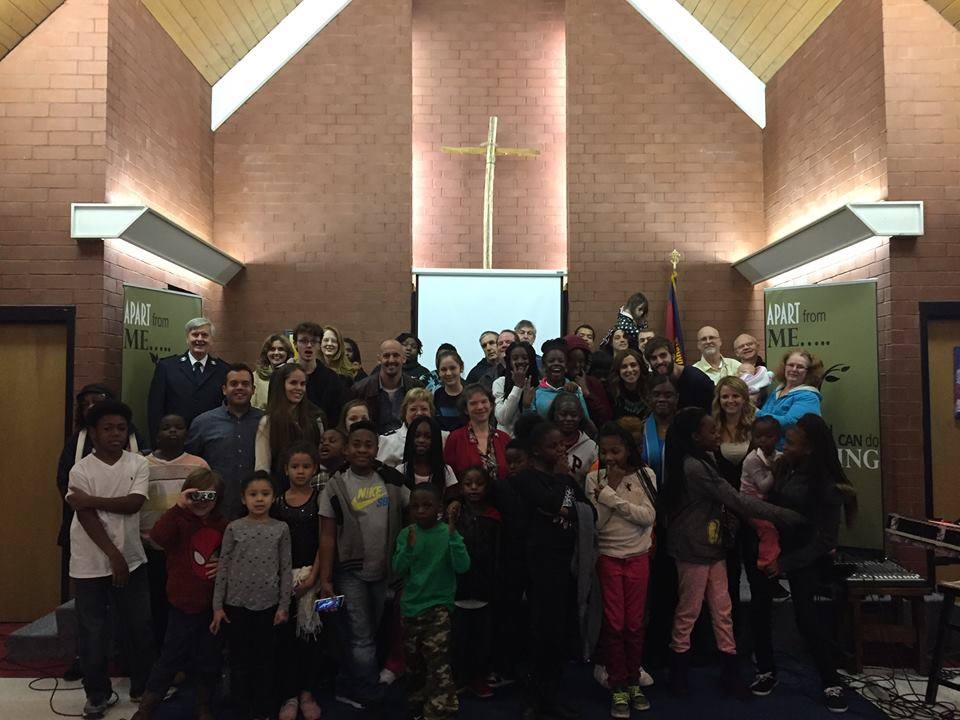
My wife and I helped oversee a nontraditional, Spirit-led church in inner city Nashville for ten years — The Salvation Army Berry Street. The meeting began with a Scripture reading. Then after Spirit-felt praise and worship people were invited to listen to the Holy Spirit and obey His promptings.
The meetings attracted intimate racial diversity that went far beyond tokenism and superficiality. We shared our hearts and our resources with one another, supported and encouraged each other, and began to know and love one another at a deep level. We learned to listen to each other and to appreciate and find God’s beauty in our racial and ethnic differences. Every time we gathered we would experience even greater love for Jesus and for each other.
One young shy black man who stuttered began coming. He eventually stood up to share something. It was painfully slow to watch, but everyone was patient and respectful toward him. You could see in his eyes the encouragement he felt. Gradually he began sharing almost every week and even began greeting people when they arrived. Over time his stuttering began to subside and although it never completely went away, he became a very effective communicator of God’s love.
To break free from the history of Sunday morning segregation, I believe we need to shift from the passive model of pastor-controlled homogenous church services to the welcoming, interactive model that the early Christians called “ekklesia.” A participatory circle free from hierarchy is inherently equalizing.
Try it and see. Gather a small group of Christ-followers. Have someone lead a prayer and ask the Holy Spirit to speak to everyone present. Then encourage everyone to be still and inwardly listen. Finally ask them if they will share what they heard. You’ll be amazed at the results.
If you live in the Nashville, Tennessee area you can experience a gathering like that every Saturday morning at 8:30 at Chile Burrito, 330 Franklin Road, Brentwood, TN 37207. Everyone is welcome.


So true