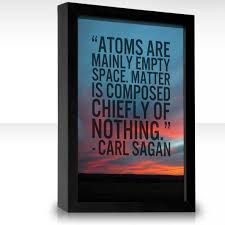
It is a matter of fact that matter (everything in the physical universe) is a mere illusion. An atom is 99.9999% empty space. In reality an atom, the building block of matter, is nothing but a force field — energy rushing around empty space at the speed of light.
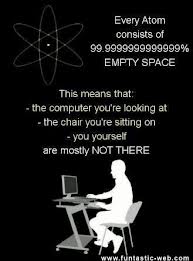
Scientists say that if every atom in the universe was to collapse into its subatomic parts, the total size of the universe would be about the size of a walnut. (Based on that idea, I figure that if everything in the world, including you, collapsed into its subatomic parts, the world would be so small, it couldn’t be seen.)
Think about it. The whole world is in reality, so small you can’t even see it. The rest is mere energy creating a grand phantom that seems real to us all.
Thus, the objective world doesn’t exist, at least not in the way that we see it, experience it, and “know” it. In spite of its apparent physicality, everything around us is in reality, no more real than a hologram. Everything that we believe is materially real, our whole natural world, is – in fact – an illusion
Concerning reality, we humans understand very little. There is a deeper degree of reality that science is not privy to. It is a more complex dimension beyond our intellect, accessible only to our inner being, our heart, our spirit. This dimension has been called intuition, faith, mysticism, spirituality, love, and God.
Untold millions of humans have testified how the living, resurrected Jesus Christ has connected them to another dimension of reality, transforming their perspective and their life. The physical world is the illusion, fading away before our eyes. Jesus is the reality — “the way, the truth, and the life.”

In this quote, a scientist ponders whether God is as real as a table:
“No scientist has ever seen an electron. No scientist soberly thinks that anyone ever could. In fact, ‘electron’ is simply the name for a set of things that happen under certain circumstances. Yet nothing is more ‘real’ to a scientist than an electron. Chairs and tables and rocks — these are in fact not very ‘real’ to a scientist, if he is thinking deeply. A table, viewed with the precise tools of the atomic physicist, is a shadowy, swirling set of electric charges, these electric charges themselves being very vague and elusive. So viewed, the table completely loses its large-scale illusion of solidity. A scientist is just the one who should not say that God is ‘unreal.’ For the scientist knows that the everyday reality of the table and the rock is an illusion, and that reality is in fact a very subtle, evasive, and somewhat abstract business.” –Warren Weaver, Ph.D.