Regardless of denomination, doctrine, or socio-economic group, church meetings follow pretty much the same format. This is true no matter where you go.
You probably know the format. It begins with a Call To Worship and then includes some singing. Next someone reads something from the Bible and/or there is some sort of Responsive Reading or other liturgy. Then there may be more singing and/or some announcements. Next an offering is taken. Sometimes there is a sacrament.
Then a person gives a talk (sermon) about some portion of the Bible. Some people listen; some daydream, some fidget, and a few may snooze. Then there is a Closing Song. The format wraps up with a Benediction. It is very difficult to find a church anywhere that doesn’t follow this (or a similar) format.
However, hidden deep in the New Testament, there is a lost church-format that is radically different from the way that almost everybody conducts church. As far as I have found, there is only one verse in the Bible that tells us how to conduct ourselves in a church meeting. It reads: “Whenever you come together, each one has a psalm, a teaching, a revelation, another language, or an interpretation.”
This is the Bible-based, lost church-format that is so rare in church services. Rather than being controlled by a person up front, this lost church-format is based on individual participation. “Whenever you come together, each one has . . .”
The lost church-format involves the Spirit-led, active participation of those attending (somewhat like a support group) rather than the passive listening of those present (like an audience). It allows God, Himself, to direct the meeting. Everybody present is called to be an active participant as moved by God’s Spirit.
The earliest Christians held church according to the lost church-format. In the 1600s the early Quakers also applied the lost church-format to their worship services. A few small groups of individual Christians, here and there, throughout church history have followed the lost church-format.
Nowadays Christians who seek to follow the lost church-format are called house church Christians. However the lost church-format can be applied in any kind of building.
The lost church-format has been widely used during the past 75 or so years by a group that doesn’t even claim to be a Christian group. Alcoholics Anonymous (AA) uses the lost church-format. They gather in their meetings and allow free and open sharing, reading, confessing, encouraging, supporting.
Why is it that an international group of people seeking freedom from the bondage to drinking would welcome the Biblical church-format that is foreign to almost all church services? 1) They are desperate for help. 2) They have no pride left, so they feel like they have nothing to lose. 3) They are willing to try a format that may cause them some discomfort and/or embarrassment. 4) They find that the lost church-format produces amazing personal and spiritual growth.
Since the Biblical, lost church-format works so well for AA, just think what it could do for churches! Come and experience the lost church-format at The Salvation Army Berry Street, 225 Berry St., Nashville, 37207 — Sunday mornings @ 10:45.
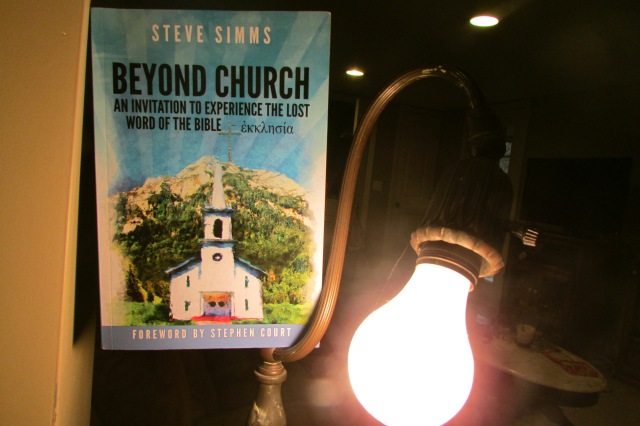
Read more in my book: Beyond Church — An Invitation To Experience The Lost Word Of The Bible, available at Amazon.