I love to express what I feel called to say. Writing helps me to open up my heart and do that. I hope that what I write helps you in some way. I hope it makes you think, encourages you, or inspires you. If it challenges you or if you disagree, I hope you know that I respect your right to have a different point of view.
Have churches confined Christianity to ear relevance? Have we turned our faith into a collection of religious ideas that we listen to on Sunday mornings rather than a lifestyle of interaction with and obedience to our living Savior? Are we hearers of the word instead of doers of the word?
Lectures, lessons, and liturgy are fine, but Biblical faith must penetrate more than the ear. It must apprehend the human heart and set it aflame with passionate love for Jesus that results in disciplined obedience to His Word and to His Holy Spirit.
When the church passively presents Christianity as only ear relevant, then society sees it as irrelevant. People move on to attitudes and behaviors that they see as more exciting and more fulfilling than religious ear tickling.
Mere verbal lessons are for beginners. But word lessons need to move into experience. Someone who hears lectures on plumbing, auto repair, or medical procedures must soon move beyond the lectures into actual hands on instruction and then into the real performance of what she/he has learned. Why should Christianity be any different? Why should our faith be bound up and reglulated to ear relevance?
Perhaps it is time for believers to take the Bible lessions that we have learned from years of sitting in on sermons and go live out what we have been taught. Maybe we should move our faith in Jesus from ear relevance to lifestyle relevance.
If we would only actively and passionately live out 10% of the religious information we have been taught in church, we could transform our lives. And we could change the world.
Who is my greatest American of all time? William Lloyd Garrison
William Lloyd Garrison was born to a poor family in 1805. As a young man he met Benjamin Lundy who published a newspaper called, the “Genius of Universal Emancipation” and was almost single-handedly speaking out against slavery. Garrison began to work with Lundy and caught a heart-felt vision for liberty and justice for all Americans. He began to work passionately and tirelessly for freedom for the slaves which was a very unpopular cause at the time, even in the North. He insisted on immediate emancipation.
Garrison and a few others founded the Anti-Slavery Society which gradually grew to have a wide influence. In 1831 he began to publish the “Liberator”, a weekly anti-slavery newspaper which at great financial sacrifice, he published until all the slaves were freed in 1865.
This caused Garrison to be hated across American. He was almost killed by a pro-slavery mob in his home town of Boston. Almost every day he received letters containing threats of violence against him. The state of Georgia even put a $5000 price on his head.
Garrison, through his non-religious Christian faith, held to his view of non-violent resistance. He believed in using persuasion (which he called “moral suasion”) rather than violence. He saw slavery for the terrible crime that it was and boldly spoke out against it no matter what it cost him personally. With fiery words, a prophets passion, and a hero’s courage he forced the country to face it’s most crucial moral issue — the act of forcibly holding three million men, women, and children in life-long servitude, bondage, and degradation while hypocritically proclaiming human freedom.
The greatest American has been mostly brushed aside by historians or pictured as a crazy radical. His greatness for the most part has been missed by American historians. But Russian novelist, Leo Tolstoy, was strongly influenced by Garrison’s non-violent direct action and wrote about it in his book, “The Kingdom of God”.
An Indian man name Gandhi read Tolstoy’s work and adopted Garrison’s non-violent direct action using it to free the nation of India from British control. A Southern American pastor, Martin Luther King, Jr., went to India to visit Mahatma Gandhi and adopted non-violent direct action as the cornerstone for the American Civil Rights Movement.
William Lloyd Garrison is my hero. Oh that we had more people like him today. A wonderful biography of Garrison is: “All on Fire” by Henry Mayer.
On this blog I have been counting down my top 10 greatest Americans of all time based on their personal commitment to (and servce for) the principles of “all men are created equal” and “liberty and justice for all”. My second greatest American, Martin Luther King, Jr., was bold and politically incorrect.
King was born into a family of black ministers in 1929 in Atlanta, Georgia. He received a bachelor’s degree in sociology from Morehouse College when only 19 years old. He went on to get a master’s degree from Crozer Theological Seminary in Chester, PA where he was the first black student body president and graduated first in his class. Next he earned a Ph.D. in systematic theology from Boston University in 1955, where he met and married Coretta Scott.
After his education he became pastor of Dexter Avenue Baptist Church in Montgomery, Alabama in 1955. In December of that year, Rosa Parks was arrested for refusing to give her seat on a bus to a white man.
The black citizens of Montgomery then formed the Montgomery Improvement Association with King as head, and began a bus boycott that lasted more than a year during which King’s life was repeatedly threatened and his home was bombed. The boycott forced Montgomery and the bus company to desegregate the buses and late in 1957 the Supreme Court declared the bus segregation law to be unconstitutional.
Afterward, King worked tirelessly leading civil rights marches and protests across the South. He elevated the idea of equal rights into a moral movement by appealing to the conscience of the nation. His use of nonviolent resistance captured the country’s sympathy due to the violence and brutality directed at non-violent protesters. Martin Luther King, Jr.’s speeches rang with passion, commitment, and justice as they stirred the souls of millions of people across America.
In 1964 King was awarded the Nobel Peace Prize and was the first black American to be named Time magazine’s “Man of the Year”. His efforts and the efforts of tens of thousands of other brave Americans led to the end of legal racial discrimination in employment, desegregation of public places, and the enforcement of voting rights for blacks and other minorities. King paid the ultimate price for freedom when he was murdered in Memphis, TN in 1968 because of his work for “liberty and justice for all”.
“When the Lord began to speak through Hosea, the Lord said to him . . .”
“There is no faithfulness, no love, no acknowledgment of God in the land. There is only cursing, lying and murder, stealing and adultery; they break all bounds, and bloodshed follows bloodshed.”
“A people without understanding will come to ruin.”
“Their rulers dearly love shameful ways.”
“I (God) wrote for them many things of My law, but they regarded them as something alien.”
“Because your sins are so many and your hostility so great, the prophet is considered a fool, the inspired man a maniac.”
“They became as vile as the thing they loved.”
“Their heart is deceitful.”
“Sow for yourselves right living, reap the fruit of unfailing love, and break up your unplowed ground; for it is time to seek the Lord until He comes and showers righteousness on you.”
“When I (God) fed them they were satisfied; when they were satisfied, they became proud; then they forgot Me.”
“He is a child without wisdom; when the time arrives he does not come to the opening of the womb.”
“Your sins have become your downfall.”
These quotations are from the NIV version of the book of Hosea.
William J. Seymour is my third greatest American of all time. He was born in 1870 in Centerville, Louisiana to former slaves. He grew up in the midst of poverty and racism and had little education — although he did teach himself to read. He became a believer in Christ at a young age and moved to Houston, TX as an evangelist in 1903.
While living in Houston, Seymour met Charles F. Parham, a white evangelist from Topeka, KS who in 1901 along with a small group of Bible school students had experienced the ancient Christian gift of speaking in tongues. Parham had been preaching about this gift every since, but had received very limited interest from people.
Parham had started a Bible school in Houston and William J. Seymour wanted to attend it. Because Parham and his students were white, Seymour had to sit outside the classroom listening through an open door because of the racist Jim Crow laws of that time.
In January 1906, William J. Seymour was invited to pastor a small holiness church in Los Angeles, CA. Although Seymour had not experienced it, he began preaching that speaking in tongues was for today and was kicked out of the church.
On April 9, 1906, William Seymour prayed for a friend to be healed of an illness and the friend began to speak in tongues. That night Seymour held a meeting in a private home and 7 people began to speak in tongues. As the news spread, crowds began to gather and more and more people began to speak in tongues.
As their numbers grew, they needed a larger place to meet, so they rented an old church building at 312 Azusa Street. For the next three years services were held three times a day, every day at 10:00 am, noon, and 7:00 pm. The crowds grew to 700-800 people inside the building with several hundred more people outside. The meetings were multi-racial and international, as people flocked to Azusa Street from all over America and all over the world.
As thousands experienced the Christian gift of speaking in tongues, their love and passion for Jesus soared to high levels. Many missionaries left Azusa Street and went to countries around the world. They were known as “missionaries of the one-way ticket” because they went to stay and to show God’s love. Many other people went back to their homes and spread “the message of Pentecost” there.
William J. Seymour preached that the main sign of the “Pentecostal experience” was not tongues, but love for all people. In a time when it was illegal for races to meet together in most of America, Azusa Street attracted all races. Seymour began to publish a newspaper called “The Apostolic Faith” and it quickly grew to 50,000 in circulation. The paper did not use by-lines and listed no editor, as Seymour wanted himself and others to keep a low profile and for God to get the glory.
Seymour and others who led and attended Azusa Street received much persecution. In September 1906, the “LA Times” wrote: “Disgraceful intermingling of the races. They have a one-eyed illiterate Negro (Seymour) as their preacher who stays on his knees much of the time with his head hidden between wooden crates.” Seymour’s attitude was: “No instrument that God can use is rejected on account of color or dress or lack of education.”
After three years, the persecution and attacks against Seymour and Azusa Street began to have an effect and the crowds gradually began to drop off. Seymour continued to pastor the Azusa Street Mission until his death in 1922. At that time only a handful of members remained.
So why is William J. Seymour my third greatest American of all time? Because of the impact of his ministry and of the Azusa Street Revival. When Seymour received the Pentecostal experience only a few thousand people in the world had received it. Through Azusa Street tens of thousands of people received it and spread it all around the world. Today it is estimated that more than 500 million people (of all Christian denominations) speak in tongues.
Pentecostalism has been called the “third force” in Western Christianity after Catholicism and Protestantism and all of the Pentecostal denominations trace their founding back to Azusa Street. This includes: Assemblies of God, United Pentecostal, Apostolic, Church of God in Christ, Four Square Gospel, and thousands more around the world. Millions of charismatics in mainline denominations and in charismatic non-denominational churches also can be traced back historically to the Azusa Street Revival.
Another reason William J. Seymour is my third greatest American is humility. Unlike modern preachers, he was not a self-promoter — he never named anything after himself. He wouldn’t even put his name or his picture in “The Apostolic Faith” newspaper. The Azusa Street services were open for anyone to testify and Seymour frequently shared the pulpit with others. He lived above the building and received a very modest salary. Most of the offering money was used to send out missionaries, to publish the paper, and to help people — not as today, to build beautiful buildings and to pay big preacher salaries.
The third reason, Seymour is my third, is that he embraced people of all “races” and demonstrated that racism can be overcome. Someone said about the Azusa meetings: “The color line is washed away in the blood of Jesus.” Azusa Street and the early Pentecostal churches were multi-racial (even in the South) in the most racist time in American history. Unfortunately the racism of America influenced the early Pentecostals and they soon began to separate along the color lines.
If God could use William J. Seymour to so impact the Church, black history, American history, and the world, what can he do with you? Why not fully give God your life and see? For more go to this link.
Tommy Lee Jones plays Thaddeus Stevens in Steven Spielberg’s new movie, Lincoln. However, many Americans have no idea who Thaddeus Stevens was.
Thaddeus Stevens was born in 1792 in Vermont to a poor family and was abandoned by his father at an early age. He was handicapped from birth because of a club foot. When he was a child all of his hair fell out and from then on he wore a wig.
Thaddeus Stevens moved to Pennsylvania at age twenty-two and became a prominent lawyer at Gettysburg and then at Lancaster. He was elected to the U.S. Congress in 1848 and in 1850 and then again in 1858 when he served until his death in 1868.
So why is he the 4th greatest American of all time? During Stevens’ lifetime, extreme racial prejudice was rampant in America. Only a couple of Northern States allowed blacks to vote. In spite of the beautiful phrase in the Declaration that says: “all men are created equal” — strict segregation and harsh discrimination were practiced throughout the North and lifetime-forced-labor and human-bondage in the South. Those who dared speak up for human rights for blacks were persecuted in the North and driven out or killed in the South.
Yet Stevens from his early adulthood went against the tide of public opinion and stood firmly and boldly against both slavery and discrimination. He said: “This is not a white man’s government! To say so is political blasphemy, for it violates the fundamental principles of our gospel of liberty.” In spite of his stand, Stevens became very powerful in Congress.
When the first Congress met after the Civil War had ended, the Southern states sent representatives and senators to Washington expecting them to be seated in congress. The men they sent were mostly former Confederate office holders. President Andrew Johnson and much of Congress thought they should be accepted back and seated. But not Thaddeus Stevens.
Stevens was greatly concerned about leaving three million freed slaves under the political control of their former masters. He knew that if the Congress seated the former Confederates, the freed blacks in the South would never get equal rights. So Stevens and the man who called the role in Congress left out the names of the Southern representatives when the role was called and refused to seat them.
Also, as the former Confederate states began to write new Constitutions in order to be readmitted to the Union, they included “black codes” which strongly discriminated against and persecuted the freed slaves. President Johnson agreed with the “black codes”. But not Stevens.
As the movie, Lincoln, shows; Thaddeus Stevens helped Abraham Lincoln get the 13th Amendment (that ended slavery in the United States) through Congress. Then Stevens almost singlehandedly influenced Congress to pass several laws and constitutional amendments providing citizenship and equal rights and voting right to blacks. He led Congress to require that Southern states agree with these laws before they be readmitted to the Union. This opened the way for blacks to be involved in politics in the South. Several blacks even became US Senators and Congressmen.
White Southerners hated Thaddeus Stevens and his courageous accomplishments for human rights. They violently opposed black freedom and eventually stopped blacks from voting, ignored the Constitutional Amendments, and set up Jim Crow laws, and enforced them through the illegal terrorism of the KKK and other vigilante groups.
But in the 1950’s and 60s blacks once again asserted their freedom. The laws and amendments that Stevens led through Congress were the legal backbone for the demands of the modern Civil Rights Movement. Thus, this brave man, helped give freedom to many millions of Americans.
Thaddeus Stevens even stood for equal rights in his death. His tombstone says: “I repose in this quiet and secluded spot Not from any natural preference for solitude But, finding other Cemeteries limited as to Race by Charter Rules, I have chosen this that I might illustrate in my death, The Principles which I advocated Through a long life EQUALITY OF MAN BEFORE HIS CREATOR.”
My fifth greatest American appears briefly in the new Steven Spielberg movie, Lincoln. At the time of the movie, Charles Sumner had already led the passage of the 13th Amendment in the US Senate, so he has only a passing role in Lincoln. Yet his role to “liberty and justice for all” was immense.
Charles Sumner was elected to the US Senate in 1851 and served until his death in 1874. He believed in equal rights for all and continually spoke out strongly against slavery on the Senate floor saying things like: “Slavery is odious as an institution, if viewed in the light of morals and Christianity.” And “Where slavery is liberty cannot be; and where liberty is slavery cannot be.” Historians consider him “the Senate’s leading opponent of slavery”. Because of this, Charles Sumner was hated by many people.
On May 22, 1856, Senator Sumner was beaten unconscious with a cane on the Senate floor by Preston Brooks, a member of the US House of Representatives, because of his anti-slavery stand. Sumner’s sever injuries kept him away from his Senate duties for three years, until December 1859.
On his return to the Senate he continued to work for the end of slavery and equal rights for all. After the Civil War, Sumner led the “radicals” in the Senate who wanted to give citizenship and voting rights to the freed slaves. He said: “It will do us no good to make the blacks as free as the whites unless we learn to have good feelings toward them and treat them well.” Due mainly to his influence in the Senate and Thaddeus Stevens‘ influence in the House of Representatives, three “Civil Rights” amendments were added to the US Constitution giving blacks citizenship, voting rights, and equal rights under the law.
Although these amendments were gradually set aside and made ineffective by the Supreme Court, leading to almost a century of segregation, racial terrorism, and Jim Crow laws, they remained in the Constitution. When the Civil Rights movement began in earnest in the 1950’s, the leaders had Constitutional rights to stand on, thanks in large part to the moral courage of Charles Sumner — my fifth greatest American.
Sumner said: “It is never too late to do right.” And “By the law of slavery, man, created in the image of God, is divested of human character and declared to be a mere chattel.”
Two sisters, daughters of a prominent South Carolina plantation owner, slaveholder, and judge; are my #6 Greatest American(s). Their names are Sarah Grimke (1792-1873) and Angelina Grimke (1805-1879).
At age 5 Sarah saw a slave being whipped and tried to board a steam boat so she could live in a place where there was no such thing as slavery. A few years later Sarah tried to teach her slave companion and “maid” to read. Sarah said: “The light was put out, the keyhole screened, and flat on our stomachs, before the fire, with the spelling book under our eyes, we defied the laws of South Carolina.” Sarah was caught and punished. Sarah was very bright but she was forbidden a formal education by her father because she was a girl.
Thirteen years younger, Angelina grew up being cared for by Sarah. She also was very sensitive to the pain and injustice being suffered by the slaves on their plantation.
As a young adult Sarah moved to the North and Angelina eventually followed her. There the sisters began to work and speak against slavery. Angelina wrote an anti-slavery letter to William Lloyd Garrison which was published in “The Liberator”, the major abolitionst newspaper. This opened the door for the sisters to become the first female speakers for the Anti-Slavery Society.
As they traveled through out the North sharing their first-hand experiences of the cruelty of slavery, their lectures received violent criticism because it was considered improper (politically incorrect) for women to speak out on political issues. The sisters had started out speaking up for the human rights of others but wound up also fighting for their own rights as women.
In 1838, Angelina presented an anti-slavery petition signed by 20,000 women to the Massachusetts legislature becoming first women in American history ever to address a state legislature. Afterward she said: “Our Lord and Master gave me His arm to lean upon and in great weakness my limbs trembling under me, I stood up and spoke.”
This is part of what Angelina said that day: “I stand before you as a Southerner, exiled from the land of my birth by the sound of the lash and the piteous cry of the slave. I stand before you as a repentant slaveholder. As a moral being I feel I owe it to the suffering slave and to the deluded master, to my country and to the world to do all that I can to overturn a system of complicated crimes.”
Both sisters boldly wrote and published widely distributed books against slavery, for women’s rights, and against racism. Sarah wrote: “Epistle to the Clergy of the Southern States” and “Letters on the Equality of The Sexes”. Angelina wrote: “Appeal to the Christian Women of the South” and “Appeal to the Women of the Nominally Free States”.
After the Civil War the sisters discovered that they had three “colored” nephews. Their brother, Henry Grimke had fathered three sons by his slave, Mary Weston. The sisters invited their nephews north and acknowledged them as family. They helped them financially and had a close relationship with two of them, Francis Grimke and Archibald Grimke — both of whom became famous civil rights leaders. Archibald even named his daughter “Angelina”.
(Read about all of my Top Ten Greatest Americans by clicking here.)
Robert Carter III of Virginia was one of the richest men in Revolutionary America. (He would have ranked near the top of the Forbes 400 List if they would have had one then.) He owned 16 plantations, 70,000 acres, numerous mansions, and several companies involved in shipping, manufacturing, and banking. He was the second largest slaveholder in Virginia “owning” almost 500 slaves.
Robert’s fortune had been handed down to him from his grandfather and then his father. His grandfather had been so rich and powerful in Virginia that he had been given the nickname “King” Carter.
Robert was born in 1728. He was raised with wealth, privilege, and the Anglican religion and enjoyed his lavish lifestyle until he was close to fifty years old.
Two things, however, began to change him. 1) He was influenced by the ideas of personal freedom and liberty as the American colonists began to talk about independence from England. During the War of Independence, Carter sided with the revolutionaries. For Carter, however, it didn’t make sense to determine freedom by skin color.
2) One of Carter’s slaves was his half-brother who was 3 years older than him and is referred to in Carter’s journals as “Baptist Billy”. In his late 40’s Carter began to attend a very unusual Baptist church where slaves, free blacks, and whites worshiped together. On July 12, 1777, Robert Carter wrote in his journal: “I doubted till very lately of the divinity of Jesus Christ. I thank Almighty God that, that doubt is removed“. Another journal entry states: “On March 15, 1778, Robert Carter and his servant Negro Sam, received tokens and the both did Commune”.
As Carter begin to enjoy fellowship with his slaves as his brothers in Christ, his heart began to change toward them. He wrote in his journal: “Man is more than a mere inanimate statue”. And: “Tolerating slavery indicates great depravity”.
As the founding fathers wrote eloquently about personal freedom, Carter tried to influence them to give freedom to the slaves of America. He wrote: “I apprehend that an act should pass here, declaring that all persons, male and female, were free from the date of the Act of Parliament declaring that the thirteen united states were free and independent states”. Eventually the northern states began to gradually free their slaves, but the southern states ignored his call. Carter later wrote: “My plans and advice have never been pleasing to the world”.
Finally in 1791 Carter acted independently against the protests of many of his friends. He wrote a document to provide freedom to his 442 slaves called “The Deed of Gift” and filed it with the state of Virginia. He began by saying: “I have for some time past been convinced that to retain persons in Slavery is contrary to the true Principles of Religion and Justice, and therefore it was my Duty to manumit them.” This was by far the largest number of slaves ever set free by an individual in American history.
Later that year, John Rippon wrote in a newspaper called “Baptist Register”: “It is said that Mr. Robert Carter of Nomini, Virginia has emancipated 442 slaves, if this be true, vote him a triumph, crown him with laurels, and let millions listen while he sings — ‘I would not have a slave to till my ground'”. Instead, America ignored and forgot Robert Carter and his wonderful document of freedom — The Deed of Gift. He was even persecuted in his home state and finally moved to Baltimore.
Robert Carter was America’s greatest founding father because he applied the principles of freedom to all people and because he believed that all lives matter including black lives. Had his example been followed by the other founding fathers American history and black history would have been radically changed and millions of Americans would not have had to suffer the cruel drudgery, bondage, and torture of slavery.
Learn about more heroes of “liberty and justice for all” in my book, Off the RACE Track. Check it out by clicking on this link.
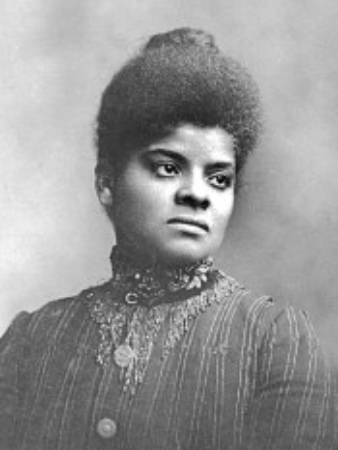
Ida B. Wells was born a slave in Holly Springs, Mississippi in 1862 — six months before Abraham Lincoln’s Emancipation Proclamation. At 14 she became a school teacher. When she was 16 both her parents died of yellow fever and Ida B. Wells moved to Memphis, Tennessee where she continued to teach school.
In 1884 Wells was ordered to move to the segregated Jim Crow car of a train. The 25-year old school teacher refused. Here’s a quote from Ida B. Wells:
“I refused. The conductor tried to drag me out of the seat, but the moment he caught hold of my arm I fastened my teeth on the back of his hand. He went forward and got the baggage man and another man to help him and of course they succeeded in dragging me out.”
Wells hired an attorney in Memphis to sue the railroad. She won the case in the local court, but the Tennessee Supreme court reversed it and she had to pay $200.00 in court costs.
People wanted to know about her experience so she began to write for black owned newspapers. Her editorials critical of the inadequate black schools caused her to lose her teaching job. Wells continued her writing and in 1889 she became a part owner of the Memphis newspaper, Free Speech and Headlight.
In 1892, three of Wells’ friends were lynched in Memphis because a white owned grocery had lost customers to their grocery store. After the murder of her friends, Wells wrote: “There is only one thing for us to do; save our money and leave a town which will neither protect our lives and property, nor give us a fair trial in courts; but takes us out and murders us in cold blood when accused by white persons.” Then a mob burned down her paper’s office and she was forced to leave Memphis under threat of her life.
Ida B. Wells settled in Chicago. In 1893 she published a pamphlet denouncing the exclusion of blacks from the Chicago World’s Fair. She also wrote a book called: Southern Horrors: Lynch Law in All its Phases. Wells worked and wrote tirelessly against lynching, for women’s right to vote, against the segregation of Chicago schools, and for many other just causes. She helped found several organizations, including the NAACP.
Wells is best known for her courageous work against lynching in America. Between 1880 and 1960, there were more than 4,000 documented lynchings in the USA. She wrote: “Brave men do not gather by the thousands to torture and murder a single individual, so gagged and bound he cannot make even feeble resistance or defense.”
Through out the years of public lynchings in America, the US government remained silent and passive. In 2005, the US Senate passed a resolution apologizing for not enacting anti-lynching legislation.
Ida B. Wells’ life-long and courageous stand against racial injustice makes her my #8 greatest American.